This is an old revision of the document!
Table of Contents
Seals around the UK
Seals as Protected Marine Species
The Tees has both species of seals which are native to the UK. Adult grey seals (Halichoerus grypus) are present in the Tees and common seals (Phoca vitulina) give birth on Seal Sands. Common seals are know internationally as harbour seals.
Information about seals around the UK - RSPCA page on seals, Wildlife Trusts - common seals, Wildlife Trusts - grey seals, JNCC - harbour seals - special areas of conservation, JNCC - grey seals - special areas of conservation, August Seal Counts - England
The Special Committee on Seals has a duty under English and Scottish law to provide scientific advice on the management of the UK seal populations - SCOS - Reports and Data. SCOS is funded by NERC - NERC - Provision of Scientific Advice on the Management of Seals.
Both species of seals are protected - MMO - Guidance Protected Marine Species - Seals
Current state of harbour seals in the Tees
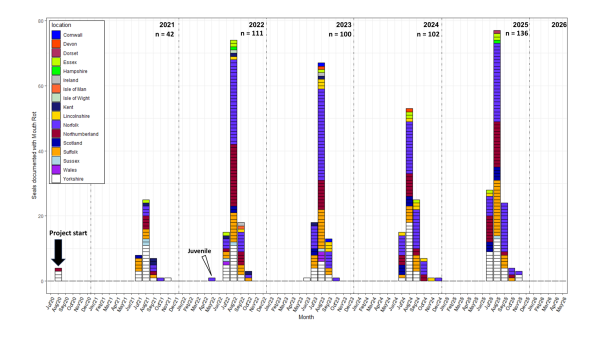
The Tees Estuary Seal Survey project TESS concludes that almost all the harbour seal pups born at Seal Sand die soon after weaning. While death symptoms may differ (mouth rot, emaciation, …) an underlying cause is likely to be the high levels of PCBs found in their blubber post-mortem. PCBs are known to cause immunosuppression and failure to thrive in harbour seals, so it seems an open and shut case. However, the counter narrative is that the seals on the Tees are thriving and in terms of adult numbers, their population is expanding in the UK. Mouth rot is found around the UK and the epidemiological argument is that the Tees population is so small that it is not possible to make such a statement. Defra has funded work to identify the novel virus that causes mouth rot and to develop a lateral flow test for that virus. INCA stated that there is nothing different about harbour seal pups on the Tees, “baby seals are always dying”. Anyway it looks like all the harbour seal pups are stranding so some sort of local seal rehabilitation provision is essential. There was an attempt this year raise funding for a suitable simple facility in Hartlepool because by the time our seals strand most rehabilitation spaces are filled, and some would not survive the long journeys to any available places.
Selection of News Stories
8th September 2022 - Record number of seals found on Teesside's shores with new research underway to find out why
23rd September 2023 - Teesmouth seals thriving or dying?
20th August 2025 - Natural England Blog: Thriving Together: Nature, People and Industry in the Tees Estuary
2nd October 2025 - Pollution kills all Tees Estuary seal pups
29th November 2025 - Defra in Denial over Tees Seal Pup Deaths
16th September 2025 - All of estuary's newborn seal pups found dead
18th September 2025 - Vet calls for seal hospital after pup deaths
9th July 2026 - Hospital plea for stranded seal pups
2026 BDMLR Facebook Posts
17th July 2026 - Yorkshire - severe case of mouth rot - euthanised
19th July 2026 - Redcar - exhausted pup with mouth rot transferred to NEST
21st July 2026 - Roker - signs of mouth rot transferred to NEST
23rd July 2026 - Middleton Beach - eye damage
5th August 2026 - Seaham - Mouth rot, but managing - Seal from Seaham recovering at NEST
Defra Funded Mouth Rot Study
Contract report on University of Teesside research into virology of seal mouth rot Cetacean Stranding Investigation Programme - ME6042
Clinical Particulars of the “Mouth Rot” Condition in Harbor Seals (Phoca vitulina) in UK Waters - IAAAM 2024
The charity British Divers Marine Life Rescue attend stranded seals around the UK. Where the seal is struggling then they take them to local vets, who can provide short term care, then the seals are relocated if possible to seal care centres. Through these call outs BDMLR have since 2021 keeping a count of case of mouth rot in stranded seals Common seal moth rot project